

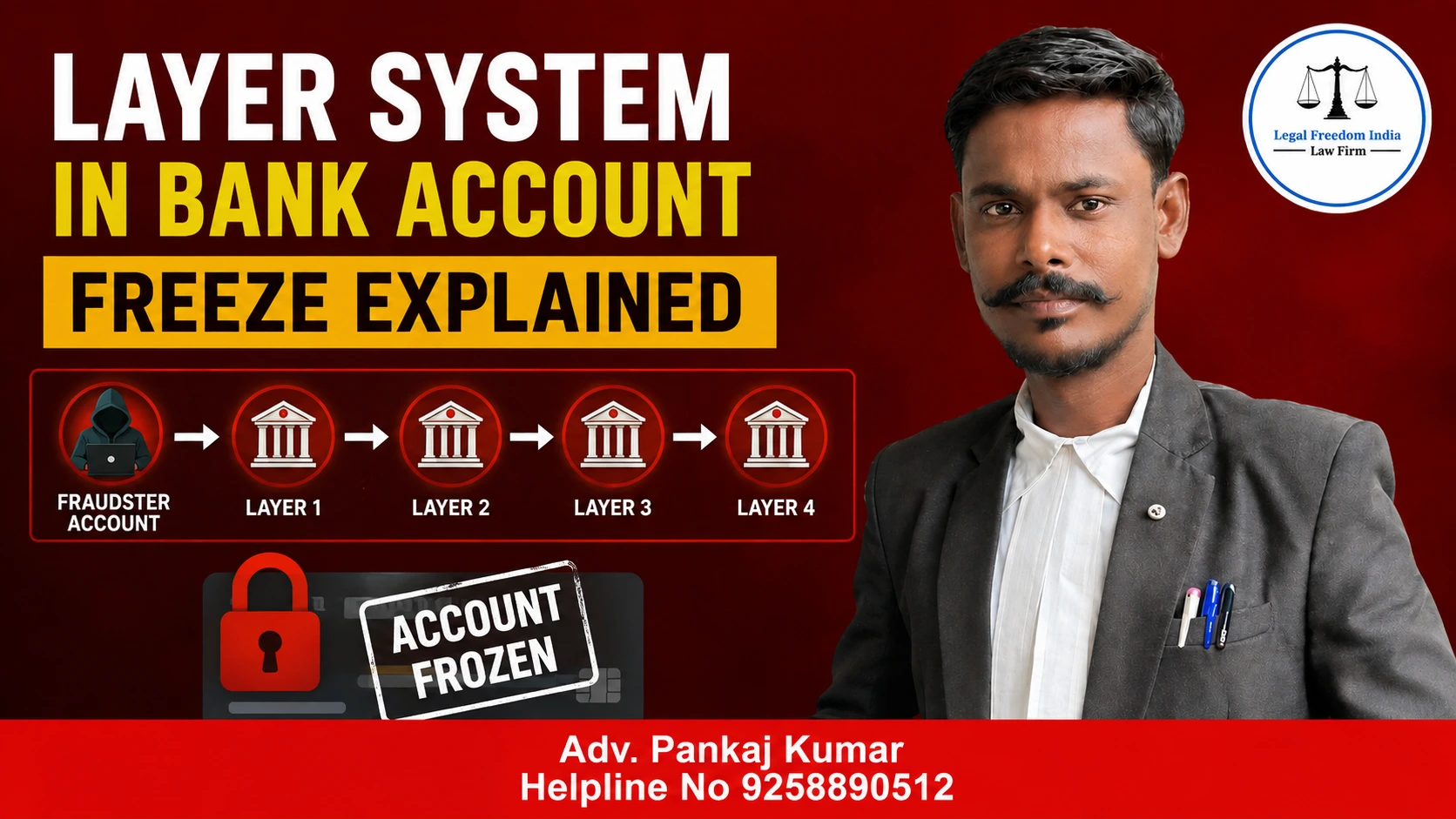
The Layer System In Bank Account Freeze Explained is important for anyone whose bank account has been frozen, lien-marked, or restricted after a cyber fraud complaint. In a typical cyber-fraud money trail, disputed funds may move through several accounts before investigators identify where the money originated and where it was transferred. These different stages are commonly described as transaction layers. An account can therefore become part of an investigation even when its owner did not knowingly participate in the original fraud. Understanding how these layers work, what evidence matters, and How to Unfreeze Bank Account Legally in India can help an account holder respond through the appropriate legal process.
What Is the Layer System in a Bank Account Freeze?
The “layer system” is commonly used to describe the sequence through which disputed money moves between accounts.
For example:
Victim → Account A → Account B → Account C → Account D
Suppose a cyber-fraud victim transfers ₹1,00,000 to Account A. Account A then transfers part of the amount to Account B. Account B transfers some funds to Account C, and Account C subsequently transfers money to Account D.
In this simplified example, each account represents a different stage of the transaction trail.
The term “layer” is generally a practical description of the financial trail. It should not be treated as a separate statutory offence or as automatic proof that every account holder in the chain participated in fraud.
The actual legal position depends on the facts, evidence, transaction purpose, knowledge of the account holder, and applicable law.
How Do Bank Account Layers Work?
A cyber-fraud transaction can involve several financial movements.
First Layer: Direct Receipt of Disputed Funds
The first layer may be the account that receives money directly from the alleged victim.
This account can become important because it is closest to the reported transaction.
Second Layer: Transfer to Another Account
The first recipient may transfer some or all of the money to another account.
The second account then becomes part of the transaction trail.
Third Layer: Further Movement
Money may subsequently be transferred to another bank account, payment platform, wallet, merchant, or other financial channel.
This creates another layer for investigators to examine.
Fourth and Later Layers
Additional transfers can create further layers.
There is no fixed number of layers in every cyber-fraud case. One matter may involve only a few accounts, while another may involve a much larger transaction network.
Why Does the Layer System Matter in Cyber Crime Investigations?
Cyber fraud often involves rapid movement of money between accounts. A fraudster may not keep the disputed funds in the first receiving account.
The money may be divided and transferred to several accounts, making transaction tracing an important part of the investigation.
Common examples include:
- UPI fraud
- Telegram investment scams
- Fake job scams
- Online trading scams
- Cryptocurrency P2P transactions
- Fake marketplace transactions
- Phishing-related payments
- Digital payment fraud
- Money-mule arrangements
The Reserve Bank of India has warned about money-mule accounts being used to receive and transfer proceeds connected with fraud. In some cases, individuals may be recruited without fully understanding the consequences, while others may knowingly participate.
Can an Innocent Account Holder Become Part of a Transaction Layer?
Yes.
An account can appear in a transaction chain because it received money from another person whose funds were later connected with a cyber-fraud complaint.
For example, assume a graphic designer receives ₹30,000 from a customer for a completed project. The designer has an invoice, email communication, project files and payment records. Later, the customer’s account becomes connected with a cyber-fraud investigation.
The designer’s account could appear in the transaction trail even though the designer had no knowledge of the alleged fraud.
The important issue is therefore not simply which layer the account belongs to. The circumstances surrounding the transaction and the available evidence also matter.
Why Can a Bank Freeze an Account in a Layer Investigation?
When disputed funds are traced through multiple accounts, the concerned investigating authority may take action concerning accounts appearing in the transaction trail.
Depending on the circumstances, the restriction may involve a particular amount or broader debit operations.
An official public notice from the Indian Cyber Crime Coordination Centre clarifies that I4C itself does not freeze or lien-mark bank accounts. Such action may be taken by the concerned law-enforcement authority or by banks under applicable regulations.
This distinction is important because an account holder should identify the actual authority or institution responsible for the restriction rather than assuming that every cyber-related freeze originates from I4C.
Also Read:
What Information Should You Obtain From the Bank?
If your account is frozen, contact the bank and request available information concerning the restriction.
Try to obtain:
- Nature of the restriction
- Lien or freeze amount
- Reference number
- Complaint details
- Transaction reference or UTR
- Investigating authority
- Police station or cyber cell
- Bank Nodal Officer details
The exact information provided by the bank can vary according to the circumstances of the case.
Keep copies of written communication, acknowledgements and documents submitted to the bank.
Also Read:
How to Unfreeze Bank Account Legally in India
If your account appears in a cyber-fraud transaction layer, the legal process should begin by establishing why the restriction was imposed.
Identify the Disputed Transaction
Review your bank statement and identify the transaction associated with the restriction.
Record:
- Transaction date
- Amount
- UTR number
- Sender details
- Recipient details
- Purpose of payment
This creates a factual foundation for your response.
Collect Financial Evidence
Gather documents explaining why the transaction took place.
Useful evidence may include:
- Bank statements
- UPI transaction records
- UTR details
- Invoices
- GST documents
- Payment receipts
- Purchase orders
- Business agreements
- Delivery records
- Email communications
- WhatsApp conversations
- Telegram conversations
- Business registration documents
Prepare a Legal Representation
A legal representation should explain the transaction chronologically.
It can identify the disputed payment, explain the legitimate purpose of the transaction, provide documentary evidence, and state your position regarding the alleged fraud.
The appropriate legal remedy depends on the nature of the restriction and the facts of the particular matter.
Follow the Applicable Legal Procedure
Some matters may involve communication with the investigating authority and bank, while others may require appropriate proceedings before a competent court.
There is no single procedure that produces the same result in every bank account freeze case.
Why Documents Matter in Layer-Based Bank Freeze Cases
A bank statement shows that money moved, but it does not necessarily explain why it moved.
For example:
“Credit: ₹50,000 via UPI”
does not tell an investigator whether the payment was for a product, service, loan repayment, refund or personal transaction.
An invoice, agreement, email, delivery record or payment receipt can provide the missing context.
For this reason, businesses, freelancers and professionals should maintain proper records of significant transactions.
What Documents Should You Preserve?
Depending on the circumstances, preserve:
- Bank statements
- UTR numbers
- UPI records
- Invoices
- GST records
- Contracts
- Purchase orders
- Payment receipts
- Delivery records
- Email communication
- WhatsApp chats
- Telegram chats
- Relevant screenshots
- Business registration documents
- Identity documents
- Bank correspondence
- Police or cyber-cell communication
Do not create false documents after a dispute arises. Preserve original records and provide accurate information.
Difference Between a Bank Lien and Account Freeze
A lien and a complete bank freeze are not necessarily the same.
Bank Account Lien
A lien may restrict access to a specified amount while other account operations may remain available, depending on the circumstances.
Bank Account Freeze
A broader freeze may restrict debit operations across the account.
The actual effect depends on the restriction recorded by the bank and the instructions received from the relevant authority.
Understanding the exact restriction is important before preparing a legal request for relief.
What Should You Avoid After a Bank Account Freeze?
Do not delete transaction records after receiving information about an investigation.
Do not remove Telegram or WhatsApp conversations that may establish the context of a payment.
Do not fabricate invoices or agreements.
Do not transfer funds merely to circumvent a restriction.
Do not provide inaccurate information to the bank or investigating authority.
Instead, preserve evidence and obtain appropriate legal advice based on the facts.
About Legal Freedom India
Legal Freedom India assists individuals, professionals, freelancers, traders, businesses and other account holders dealing with bank account freezes, bank account liens, debit restrictions, cyber crime investigations and disputed financial transactions across India.
The platform focuses on legal assistance where banking restrictions intersect with cyber crime complaints and financial transaction disputes.
Cyber Crime Representation
Legal Freedom India assists clients in preparing representations concerning cyber crime complaints, disputed transactions and account restrictions.
Bank Account Unfreeze Assistance
Legal guidance is provided to account holders dealing with frozen or restricted bank accounts.
Bank Account Lien Assistance
Assistance is available for matters involving restrictions over specific amounts or disputed funds.
Legal Drafting
Legal Freedom India assists with representations, replies, applications and supporting legal documents based on the facts of the case.
Bank Coordination
Assistance may involve communication with relevant bank officials and nodal officers concerning account restrictions and supporting documentation.
Court Assistance
Where judicial intervention is appropriate, Legal Freedom India can assist clients with understanding and pursuing the applicable legal process.
For additional legal resources, visit the Legal Freedom India Blog.
Also Read
For information about common reasons behind bank account restrictions, read Kyu Hota Hai Bank Account Freeze.
For additional information about frozen account assistance, read How to Unfreeze Bank Account Online & Get Legal Help.
For cyber-law related assistance, visit Best Cyber Advocate in Maharashtra.
Official Resources for Cyber Crime and Banking
The National Cyber Crime Reporting Portal is the Government of India’s official platform for reporting cyber crime and financial cyber fraud.
The portal provides information and facilities for reporting financial cyber fraud and other cyber offences.
For banking-related regulatory information, visit the Reserve Bank of India.
RBI materials also provide information concerning banking security, money-mule accounts and responsible use of banking channels.
Frequently Asked Questions
What is the Layer System In Bank Account Freeze Explained in simple terms?
It is a commonly used description of the sequence of accounts through which disputed or suspected fraudulent funds may move during a financial investigation.
Does being in a particular layer mean I committed cyber fraud?
No. The appearance of an account in a transaction trail does not by itself establish criminal liability. The transaction circumstances, evidence, knowledge and applicable law are relevant.
Why can an innocent person’s bank account be frozen?
An account can appear in a transaction trail because it received funds that were later connected with a reported cyber fraud. The account holder may not have known the source of the funds.
Is there a fixed number of layers in cyber fraud?
No. The number of transaction stages varies from case to case. Some investigations may involve only a few accounts, while others may involve numerous transactions.
What documents can help explain my transaction?
Bank statements, UTR numbers, invoices, agreements, GST records, payment receipts, delivery records, emails and relevant WhatsApp or Telegram conversations can help establish the purpose of a transaction.
Is a lien the same as a complete bank freeze?
No. A lien may restrict a particular amount, while a broader freeze can affect account debit operations. The exact restriction should be confirmed with the bank.
Who actually freezes a bank account in a cyber investigation?
The authority responsible depends on the circumstances. An official I4C notice states that I4C itself does not freeze or lien-mark bank accounts; such action may be taken by the concerned law-enforcement authority or banks under applicable regulations.
How can I begin the process to unfreeze my account?
Start by obtaining the restriction details from your bank, identifying the relevant transaction and authority, preserving supporting evidence, and determining the appropriate legal process based on the facts of the case.
Can Legal Freedom India help with layer-system bank freeze cases?
Yes. Legal Freedom India provides assistance concerning bank account freezes, liens, cyber crime investigations, legal drafting, bank coordination and appropriate court-related proceedings.










Contact Legal Freedom India
Have a legal query? Our experts are just a message away.