

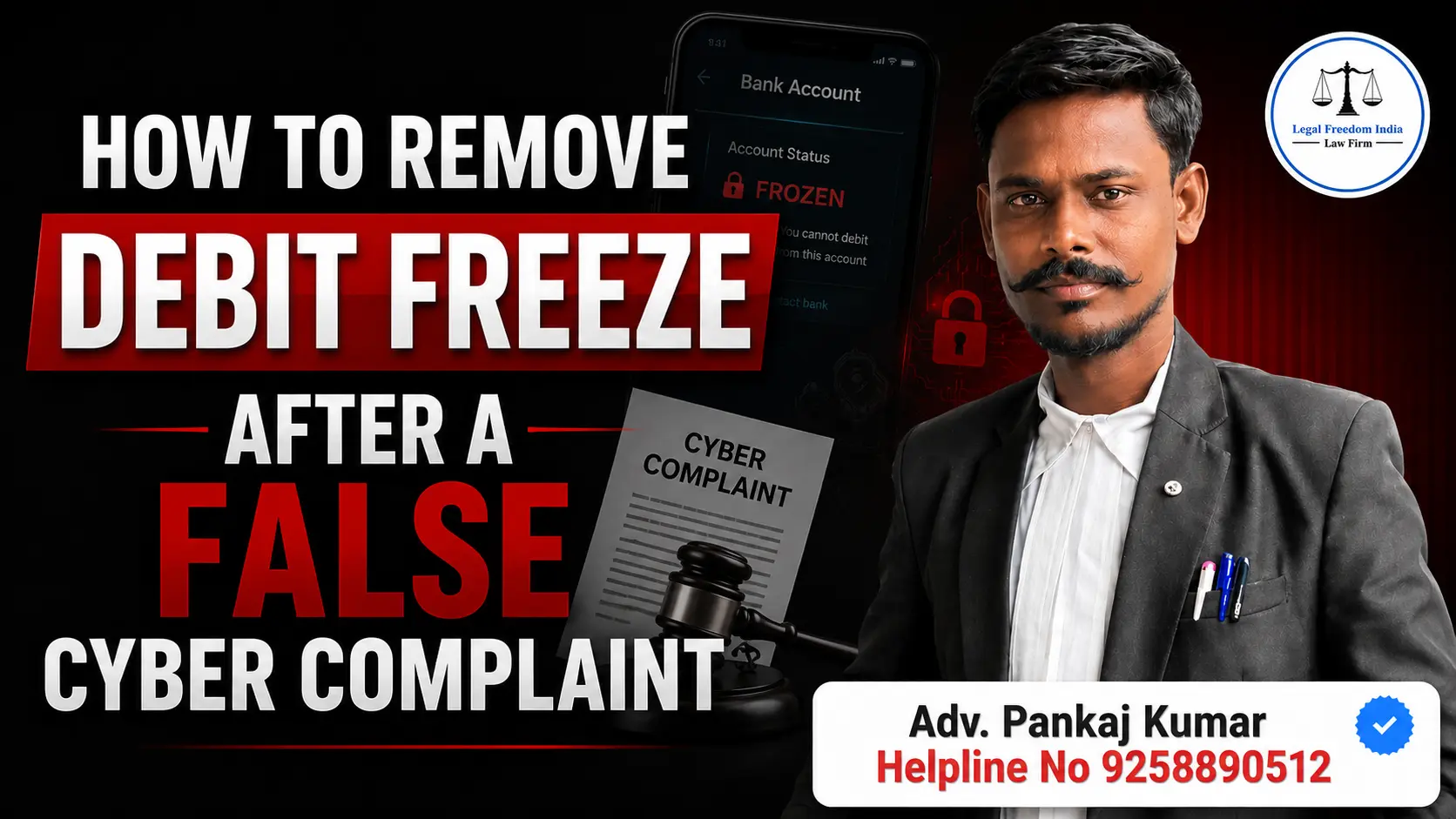
How to Remove Debit Freeze After a False Cyber Complaint is a common concern when a person’s bank account becomes restricted because their transaction has allegedly been connected with a cyber-fraud complaint. A debit freeze can prevent withdrawals, UPI payments, transfers and other debit transactions even when the account holder believes the complaint is incorrect or that they have no involvement in the alleged fraud. The appropriate response is to identify the source of the restriction, preserve transaction evidence, communicate with the bank and, where necessary, pursue the appropriate grievance or legal process.
What Is a Debit Freeze After a Cyber Complaint?
A debit freeze generally means that outgoing transactions from a bank account have been restricted. Depending on the circumstances, the restriction may affect the entire account, a particular amount, or specific debit operations.
A cyber complaint can create a problem when the investigating authority traces disputed or allegedly fraudulent funds through several bank accounts. An account holder may therefore appear in a transaction chain without necessarily being the person who committed the underlying fraud.
The exact nature of the restriction matters. A debit freeze, lien, hold, partial restriction and complete account freeze are not necessarily the same thing. Legal Freedom India’s existing guidance also explains that bank restrictions can take different forms, including debit freezes, liens and holds. (Legal Freedom India)
Why Can a Bank Account Be Debit Frozen?
Cyber Fraud Transaction Trail
One reason is that money connected with a reported cybercrime may have moved through the account. Investigators may examine the transaction chain to determine where the money came from and where it subsequently went.
This can create difficulties for legitimate account holders who received money through an ordinary transaction but later discover that the payment has been connected to a complaint.
Suspicious or Disputed Transaction
A disputed transaction can also result in additional scrutiny. Unusual credits, multiple transfers, third-party payments or transactions that cannot immediately be explained may require clarification.
Direction From an Investigating Authority
In some cases, the bank may be acting on communication or instructions received from an investigating authority. Therefore, simply asking the bank to remove the restriction may not immediately resolve the matter if the underlying restriction is connected with an investigation.
How to Remove Debit Freeze After a False Cyber Complaint
Step 1: Find Out the Exact Nature of the Restriction
Do not begin by assuming that the account is completely frozen.
Ask the bank for available information regarding:
- Whether the account has a debit freeze or full freeze
- Whether a specific amount has been placed on hold
- Whether a lien has been marked
- Whether the restriction is connected with a cybercrime complaint
- The relevant transaction reference, if available
- The authority or investigating agency mentioned in the bank’s communication
The objective is to establish exactly what restriction has been placed on the account.
Step 2: Collect the Complete Transaction Trail
If the disputed transaction is genuine, prepare evidence showing the complete background of the payment.
Useful documents can include:
- Bank statements
- UTR or transaction reference numbers
- UPI transaction records
- Payment receipts
- Invoices
- Chat records relating to the transaction
- Screenshots of relevant communications
- Source-of-funds documents
- Salary or business records
- Proof explaining why the payment was received
- Bank SMS or email concerning the freeze
Do not selectively provide only documents that appear favourable. A consistent transaction history is generally more useful than an incomplete explanation.
Step 3: Prepare a Clear Explanation
A false cyber complaint can become more complicated when the account holder gives inconsistent explanations.
Prepare a chronological explanation:
Who sent the money → why it was received → when it was received → what happened afterward → whether the money was transferred → what evidence supports the transaction.
If the transaction was legitimate, explain the commercial or personal purpose behind it and attach supporting records.
Step 4: Approach the Bank Through a Formal Channel
Contact the bank through its grievance mechanism and submit the relevant documents.
Request clarification regarding the debit restriction and explain why the disputed transaction does not represent fraudulent activity by you.
Keep copies of:
- Complaint/reference number
- Emails
- Letters
- Bank replies
- Submitted documents
- Statements
- Communication with the branch or grievance officer
A documented communication trail can become important if the issue remains unresolved.
What If the Cyber Cell Is Involved?
If the debit freeze originates from a cybercrime investigation, the matter may require communication beyond the bank.
India’s National Cyber Crime Reporting Portal is designed to facilitate reporting of cybercrime complaints, with complaints handled by the relevant State/UT police authorities. The official citizen manual also states that the portal is for facilitating cybercrime reporting and should not itself be treated as an FIR. (Cyber Crime India)
If your account has been included in an investigation because of a transaction trail, the relevant records should be organized before responding.
The objective should not simply be to demand an immediate unfreeze. The stronger approach is to demonstrate, through documents and a consistent explanation, why your account and the disputed transaction should not be treated as proceeds of fraud.
Can a False Cyber Complaint Be Challenged?
A person who believes that their account has been wrongly restricted should not ignore the issue.
Depending on the facts, possible steps can include:
- Formal representation to the bank.
- Submission of transaction evidence.
- Communication with the relevant investigating authority.
- Request for clarification regarding the restriction.
- Appropriate grievance escalation.
- Legal representation where the restriction continues or requires judicial intervention.
The correct remedy depends on the source of the freeze, the nature of the allegation, the amount involved and the stage of the investigation.
What If the Bank Does Not Resolve the Problem?
There is an important distinction between a dispute about the bank’s service and a restriction arising from an external investigation.
For bank-service grievances, the Reserve Bank of India’s current Reserve Bank – Integrated Ombudsman Scheme, 2026 provides a cost-free grievance mechanism for eligible complaints involving deficiency in service by covered regulated entities. The current scheme came into force on July 1, 2026.
The RBI’s framework requires customers to follow the applicable complaint process and maintain the relevant facts and documents.
Therefore, if the issue is specifically an unresolved banking-service grievance, the RBI mechanism may be relevant. However, an Ombudsman complaint should not automatically be assumed to replace a legal remedy where the restriction is based on an active police or cybercrime investigation.
RBI Complaint Management System / Ombudsman information
Documents That Can Strengthen Your Case
Transaction Evidence
Provide complete statements and transaction references rather than isolated screenshots.
Source of Funds
If the disputed amount came from a customer, employer, friend, business partner or another legitimate source, supporting records can help establish the transaction’s purpose.
Communication Records
Relevant emails, messages, invoices and payment discussions can help explain why the transaction occurred.
Identity and Account Documents
Keep KYC documents and account-related records available where they are legitimately required.
Legal Freedom India and Bank Account Freeze Matters
Legal Freedom India focuses on legal guidance relating to bank account freezes, cyber complaints, transaction disputes and related financial restrictions. Its existing bank-freeze resources explain different forms of restrictions and why an account may become involved in a cyber-fraud transaction trail. (Legal Freedom India)
You can explore its bank-account and legal articles for related information.
For background on why accounts can be restricted, read Why Does a Bank Account Get Frozen?.
Also read:
- How to Unfreeze Bank Account Online – Legal Help for Frozen Account Issues
- Best Cyber Advocate in Maharashtra – Legal Help for Cyber Fraud & Frozen Bank Accounts
What You Should Not Do After a Debit Freeze
Do Not Delete Transaction Records
Deleting messages, payment records or account information can make it harder to establish the transaction history.
Do Not Give Contradictory Explanations
Your explanation should remain factually consistent with your bank statement and supporting documents.
Do Not Ignore the Restriction
A debit freeze connected with a cyber complaint should be addressed promptly rather than left unresolved.
Do Not Assume That Every Freeze Means You Are Accused
An account can become relevant to an investigation because of a transaction trail. Legal Freedom India’s guidance similarly notes that an innocent account holder can sometimes be affected when their account becomes part of a disputed fund trail. (Legal Freedom India)
Frequently Asked Questions
Can a bank freeze my debit transactions because of a cyber complaint?
Yes, a bank account can be subject to restrictions connected with a cybercrime investigation or disputed transaction. The exact authority and legal basis should be identified from the available bank communication.
How long does a debit freeze remain?
There is no single universal period applicable to every case. Duration depends on why the restriction was imposed, the investigating process, the bank’s actions and whether the underlying issue has been resolved.
Can an innocent person’s account be frozen?
An account holder may be affected even when they did not commit the underlying fraud, particularly when their account appears in a disputed transaction trail. The account holder should preserve evidence explaining the transaction.
Can I ask the bank to remove the debit freeze?
Yes, you can formally approach the bank and request clarification and review. If the restriction is based on an external investigation, however, the bank may require appropriate communication or clearance from the relevant authority.
What should I do if the cyber complaint is false?
Collect the complete transaction evidence, prepare a factual explanation, communicate formally with the relevant parties and obtain appropriate legal advice where necessary. Avoid making unsupported allegations or submitting inconsistent information.
Can I complain to RBI about a frozen bank account?
The RBI’s Integrated Ombudsman Scheme provides a grievance mechanism for eligible complaints involving deficiency in service by covered regulated entities. However, an account restriction arising from an active law-enforcement investigation may involve issues beyond an ordinary banking-service complaint.
Conclusion
How to Remove Debit Freeze After a False Cyber Complaint requires more than repeatedly contacting the bank. First identify the exact restriction, determine whether it is a debit freeze, lien or hold, preserve the complete transaction trail and prepare documentary evidence explaining the disputed payment. If the restriction is connected with a cyber investigation, the matter may require communication with the relevant authority in addition to the bank. For unresolved banking-service issues, the RBI’s applicable grievance mechanism may also become relevant.
The key is to build a clear factual record rather than treating the freeze as a simple technical banking problem. This article is general legal information and is not a substitute for case-specific legal advice.










Contact Legal Freedom India
Have a legal query? Our experts are just a message away.